Each project starts with the outcome, the working conditions, and the checks that determine whether it works.
Some are working tools. Others are tests. The status is listed with each project.
Independent labs
Small builds used to test one interface, behavior, or operating question at a time.
01 / Choice lab
Design Studio
Outcome
Help non-designers give useful design direction through choices instead of design vocabulary.
Context
People can recognize what they prefer but often cannot explain it in terms a designer can use.
Requirements
Present comparable options, record each choice, and carry the pattern into the next brief.
Verification
Compare predicted preferences with the person's next set of choices.
Status
Working prototype. Predictive value is still under test.
FIGURE 12 · evolution loop
How preference learning works
Each recorded choice narrows the set shown in the next round.
What the figure showsThree rounds run in order: eight options, then four, then two. Each round records the choice, and the choice loops back to narrow the round after it. The loop stops when the remaining options no longer change the brief.
02 / Personal signal reader
Optimus
Outcome
Turn news, messages, email, tasks, and captured ideas into one ranked feed for reading and action.
Context
Important signal was spread across separate streams, while reminders and low-value items competed for the same attention.
Requirements
Keep every item tied to its source, explain why it ranked, place the next action with it, and learn from reads, saves, and corrections.
Verification
A user can review fresh items, complete an action from its card, and see later rankings respond to explicit feedback.
Status
Private working system. Feed, reader, actions, and preference learning are shipped; the interface is not public.
FIGURE 13 · operating map
Many streams become one feed that learns
The action stays with the item, and each choice improves the next ranking.
What the figure showsNews, email, messages, tasks, and captures enter one priority rank based on source trust, freshness, learned preference, and whether the item needs action. The ranked item appears with read, reply, save, schedule, and dismiss controls. Reads, saves, and “not important” corrections tune the next ranking.
03 / Model bakeoff
Barber Bakeoff
Outcome
Compare coding agents on the same product problem instead of relying on demos or reputation.
Context
Different agents make different assumptions about trust, habit, taste, and proximity in a local-service marketplace.
Requirements
Give every agent the same brief, source material, constraints, and acceptance checks.
Verification
Score the working builds against the same criteria and record where each agent failed.
Status
Completed experiment. The results apply to this brief, not every coding task.
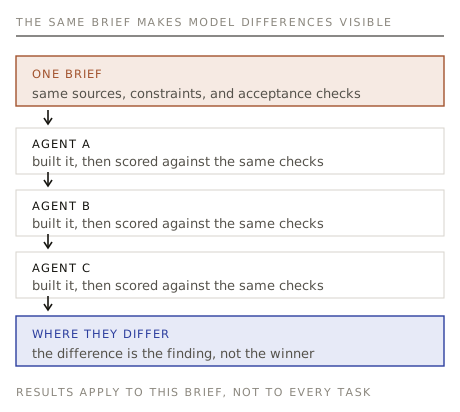
FIGURE 14 · comparison arena
The same brief makes model differences visible
Differences only mean something when the inputs were identical.
What the figure showsOne brief carries the same sources, constraints, and acceptance checks to three agents. Each agent builds, then is scored against those same checks. Where they diverge is the finding; the results apply to this brief rather than to every task.
04 / Capability lab
MediaUnwired
Outcome
Let household members use a home-media server without learning how it is configured.
Context
The server works, but its queues, file health, and maintenance controls are written for the person who built it.
Requirements
Use plain controls for watching, fixing a queue, and understanding whether media is available.
Verification
Household members complete common tasks without help or access to the server setup.
Status
Working household tool. Task testing is still open.
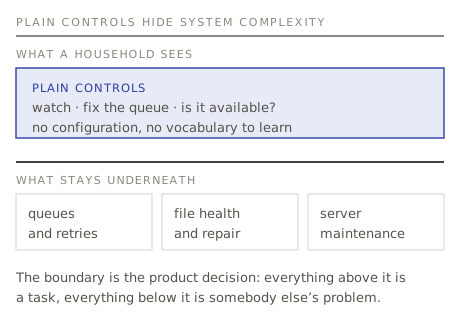
FIGURE 15 · operating map
Plain controls hide system complexity
The boundary is the product decision, not the technology under it.
What the figure showsAbove the line is what a household sees: watch, fix the queue, is it available — no configuration and no vocabulary to learn. Below it sit queues and retries, file health and repair, and server maintenance. Everything above the line is a task; everything below it is somebody else’s problem.
Offbrain system
Offbrain organizes research from the source through the recommendation. The projects below cover storage, recruitment, monitoring, and public-source work.
05 / Concept
Offbrain
Outcome
Make a large research corpus searchable while keeping every answer tied to evidence.
Context
Voice notes, field observations, transcripts, and market notes were spread across tools and hard to retrieve together.
Requirements
Transcribe, tag, validate, connect, group, and retrieve records without separating them from their sources.
Verification
Sampled answers open the supporting record, and the record opens the original recording or document.
Keep the evidence and working reasoning behind a recommendation.
Context
Research decisions often survive after their source material and assumptions become difficult to find.
Requirements
Store context, sources, notes, review rules, and the resulting decision together.
Verification
A reviewer can trace a recommendation back through the working notes to the original evidence.
Status
Original concept under test.
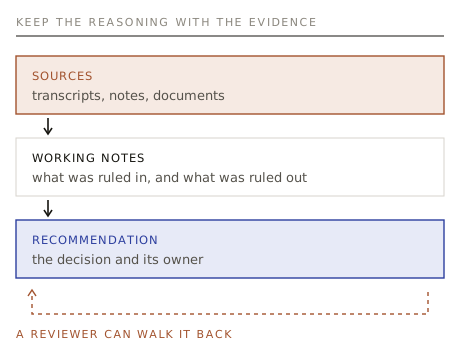
FIGURE 16 · source-trace map
Keep the reasoning with the evidence
A recommendation stays reviewable when its sources travel with it.
What the figure showsTranscripts, notes, and documents feed the working notes, which record what was ruled in and what was ruled out. Those feed the recommendation and its owner. The return path is the requirement: a reviewer can walk the decision back to the material it came from.
07 / Property
Get
Outcome
Let a business user recruit the right participants without translating every filter through a researcher.
Context
Business audience descriptions do not map cleanly to screener criteria or available participants.
Requirements
Turn audience definitions into explicit criteria, show the available pool, and preserve exclusions.
Verification
Recruited participants meet the approved criteria and every exclusion is accounted for.
Status
Original concept under test.
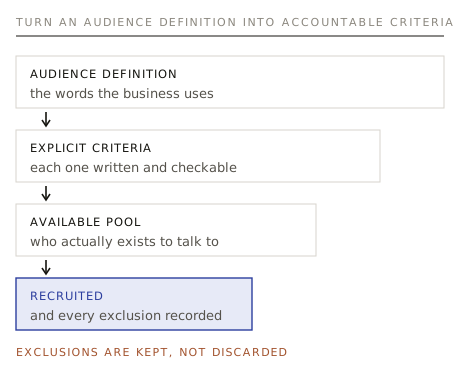
FIGURE 17 · funnel with exclusions
Turn an audience definition into accountable criteria
Recruitment is accountable when it records who did not qualify.
What the figure showsThe words the business uses become explicit criteria, each one written and checkable. Those narrow to the pool who actually exist to talk to, and then to the people recruited. Exclusions are kept rather than discarded, so every person screened out is still accounted for.
08 / Property
Pulse
Outcome
Show when new evidence is strong enough to require a research review.
Context
Measures change continuously, but most movement does not justify a new study or recommendation.
Requirements
Monitor approved measures, record the threshold, and route meaningful changes to review.
Verification
Each alert shows the measure, threshold, source, and reason a review was triggered.
Status
Original concept under test.
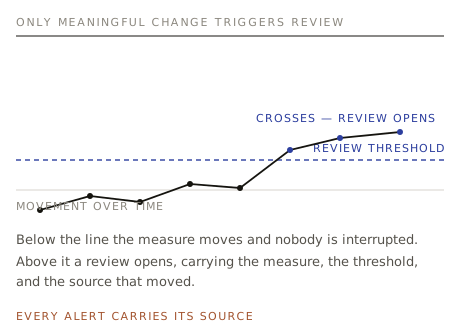
FIGURE 18 · threshold timeline
Only meaningful change triggers review
Movement is not the signal; crossing the stated threshold is.
What the figure showsA measure moves over time under a marked review threshold. Below the line the measure moves and nobody is interrupted. Above it a review opens, carrying the measure, the threshold, and the source that moved.
09 / Independent app
Offbrain Inject
Outcome
Turn public-source material into a brief without treating repetition as proof.
Context
Public records arrive in inconsistent formats and can overrepresent the loudest or most repeated claim.
Requirements
Keep the original source, extract consistent fields, separate frequency from evidence, and show uncertainty.
Verification
Every brief statement resolves to a source record and unsupported claims are excluded or marked.
Status
Independent app under test.
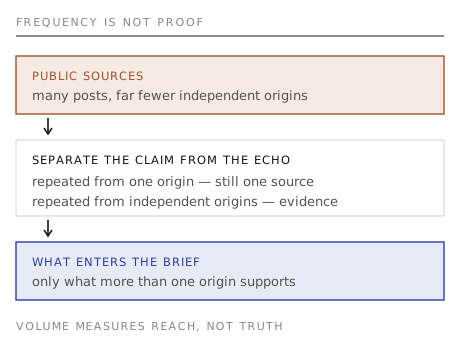
FIGURE 19 · source-trace map
Frequency is not proof
Repeating one origin is not the same as independent support.
What the figure showsPublic sources arrive as many posts and far fewer independent origins. The claim is separated from the echo: material repeated from one origin is still one source, while material repeated from independent origins is evidence. Only what more than one origin supports enters the brief, because volume measures reach rather than truth.